Are Spiders in Bali a Problem for Travelers?
For most visitors, spiders in Bali are not a problem. That’s the short answer.
Bali’s climate - 77 to 89°F (25 to 32°C), humidity running 70 to 90% - and dense vegetation support a high natural spider density, especially in rural areas. But the species you’re likely to see are either small house spiders under a centimeter long, or large web-builders and huntsman that look alarming and do essentially nothing to humans (4). Bali-based operators consistently report no widespread fatal species on the island and no pattern of emergency-department visits for spider bites (4)(5).
Where you’ll notice them:
- Open-plan villas with garden bathrooms, thatched (alang-alang) roofs, or open ceilings - encounters can be weekly in lush zones
- Jungle-edge stays around Ubud, Sidemen, north Bali, and the rice-field belt north of Canggu
- Outdoor lights left on overnight, which attract the insects that attract orb-weavers
- Gardens and pool areas in the early morning, where overnight webs catch the dew
Where you won’t really notice them:
- High-rise hotels and sealed-window apartments in Kuta, Legian, and Nusa Dua
- Managed villas (USD $80-150/night) with monthly pest-control contracts
- Beachfront resorts with active landscaping crews
If you’re in Bali for five to seven days on a beach holiday in Seminyak or Nusa Dua, you may not see a single spider indoors. If you’re renting a $40/night homestay in a rice field for a month, expect to share the space.
What Types of Spiders Are in Bali?
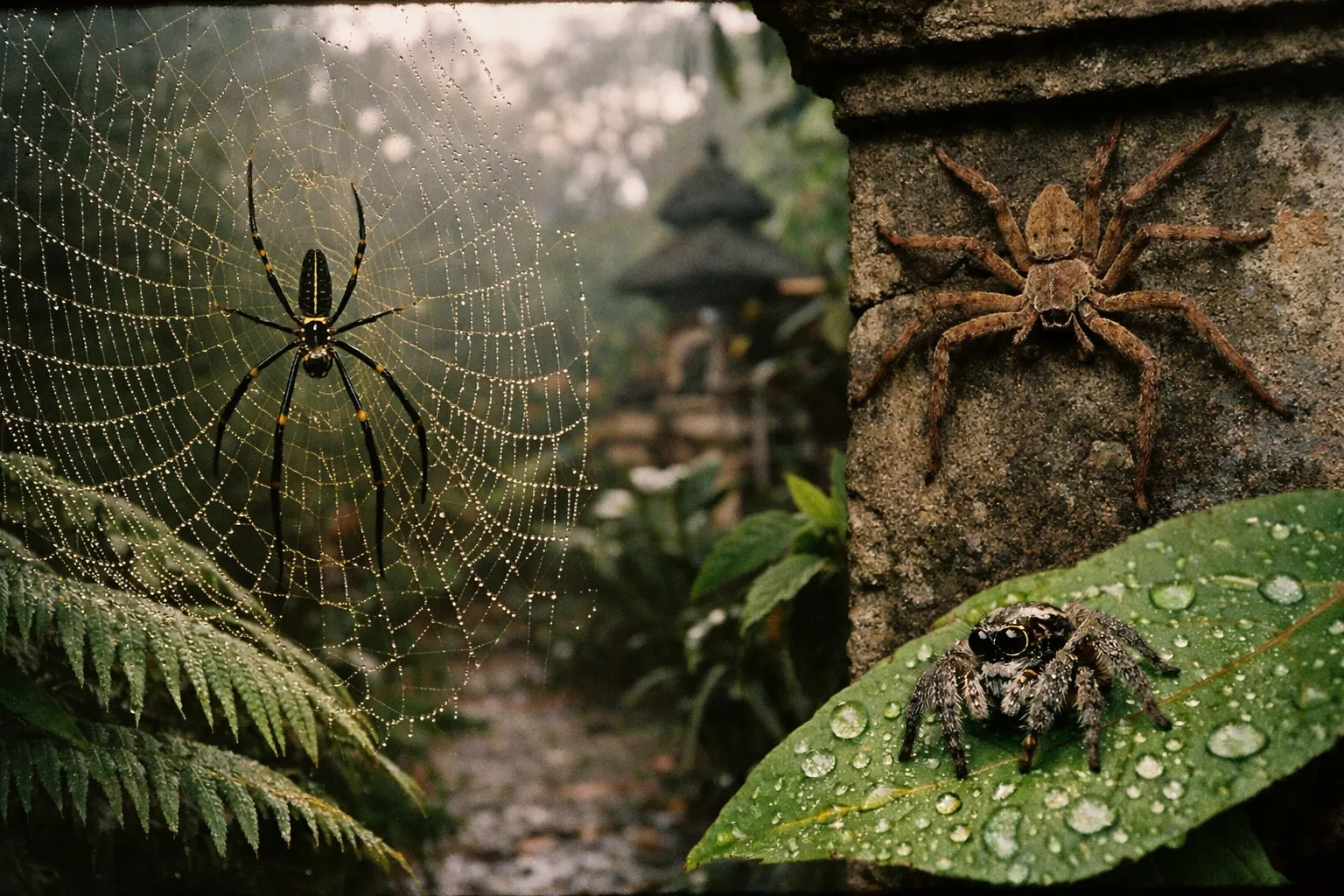
Finns Beach Club’s field guide lists more than 60 recognizable species across the island (3), and broader estimates put the true arachnid count in the thousands once you include small, undescribed species (1). For trip-planning purposes, you only need to know about eight or nine.
| Species | Approx. size (leg span) | Where you’ll see it | Danger to humans |
|---|---|---|---|
| Giant Golden Orb-Weaver (Nephila pilipes) | Up to 12 cm (5) | Forests, gardens, between trees | None - large web, shy spider |
| Black Golden Orb-Weaver | Up to 8 cm (5) | Gardens, jungle edges | None |
| Hawaiian Garden Spider (Argiope appensa) | ~2-3 cm body | Rice fields, agricultural land | None |
| St Andrew’s Cross Spider | 2-3 cm | Open sunny gardens | None |
| Pantropical Huntsman (Heteropoda venatoria) | ~10 cm (4) | Walls, ceilings, bathrooms | Bite painful but not medically serious |
| Common House Spider | Under 1 cm (1) | Corners, behind furniture | None |
| Jumping Spider (Salticidae) | 1-2 cm | Everywhere, often on walls | None |
| Wolf Spider | 3-5 cm | Ground level, gardens at night | Bite mildly painful, not serious |
| Javan Rustleg Tarantula (Selenocosmia javanensis) | Up to 16 cm | Forest floors, burrows (Bali Barat) | Defensive bite painful, not life-threatening |
Orb-Weavers: The Ones in the Big Webs
These are the dramatic ones - the spiders strung across a 2-meter web at face height when you walk to breakfast. The Giant Golden Orb-Weaver produces visibly gold-tinted silk and is the species most often photographed by tourists who think they’ve found something dangerous. They haven’t. Females are large; males are tiny and hide nearby.
Walk the Tegallalang Rice Terraces early in the morning and the dew highlights dozens of these webs at once. Worth the detour for photography, trivial as a safety concern.
Huntsman Spiders: The Ones on the Wall
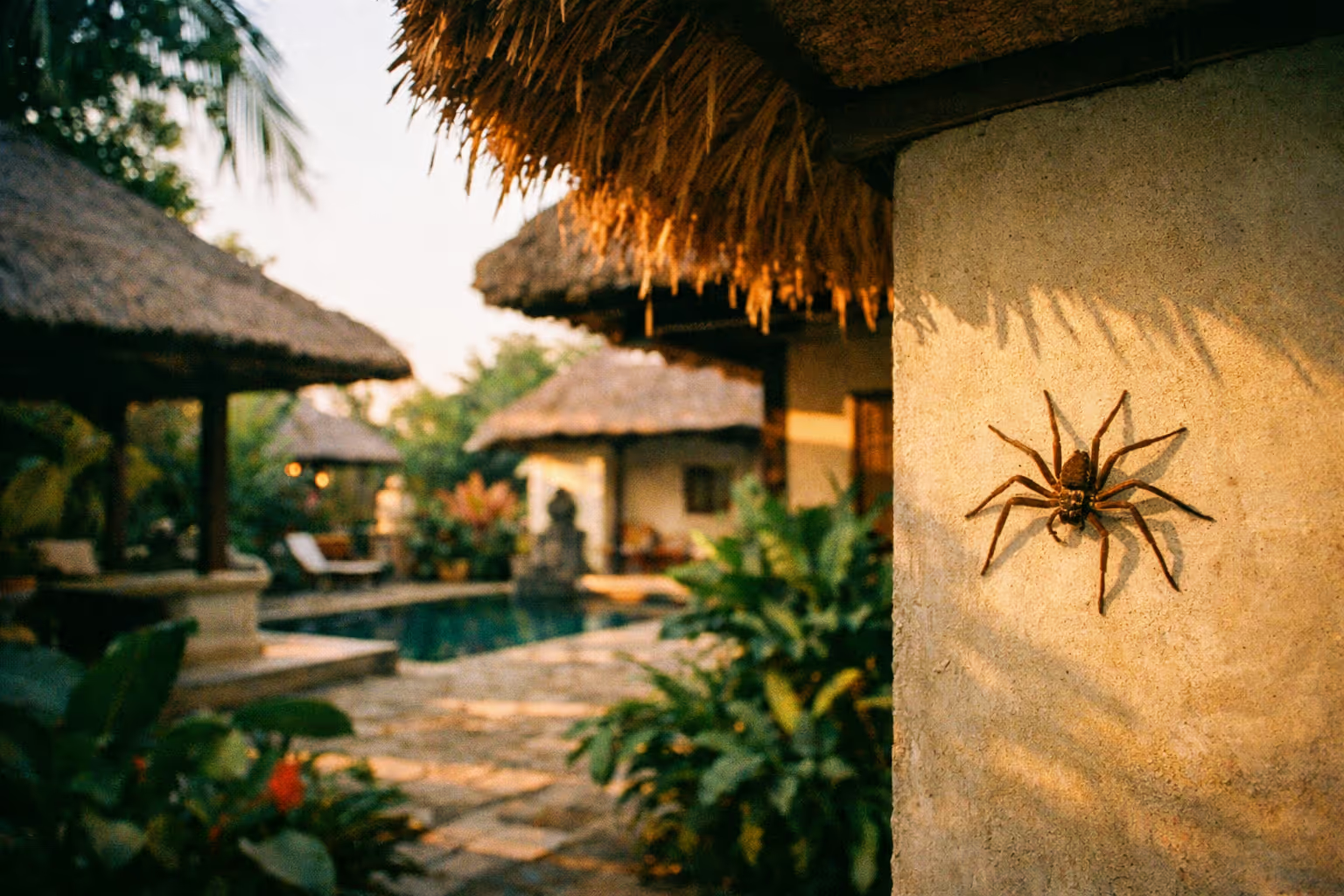
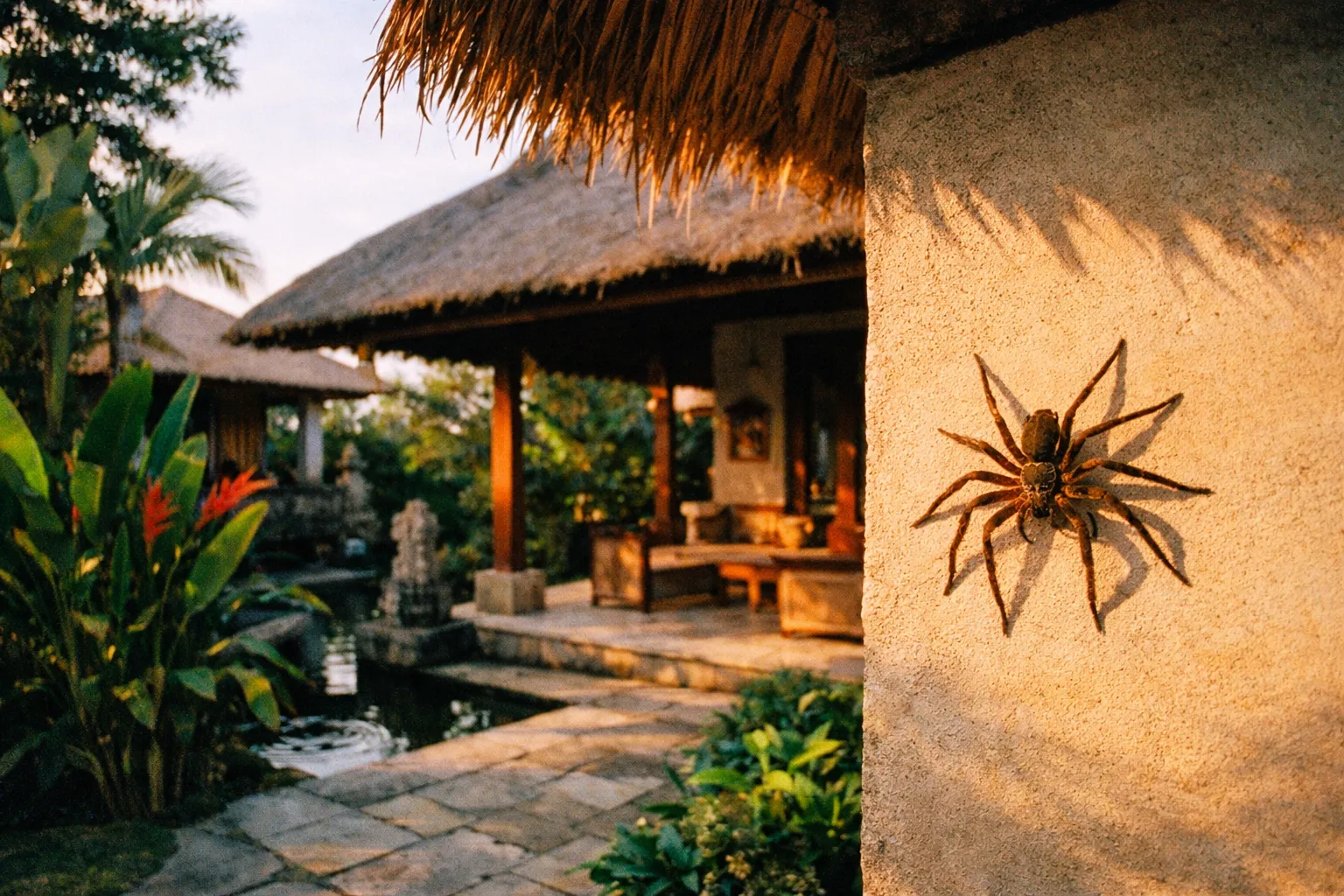
If you’re going to lose sleep over one species, it’ll be this one. Pantropical huntsman have a leg span typically around 10 cm (4) - occasionally larger in older females - they’re flat, they’re fast, and they prefer walls and ceilings - which means they show up at eye level in villa bathrooms. They are not aggressive. A bite causes localized swelling similar to a wasp sting (5), and locals generally consider them useful because they eat cockroaches and large insects.
To remove one: turn on all the lights, open a door, and herd it out with a soft broom. Two to three minutes, no contact required.
Jumping Spiders: The Small, Smart Ones
Salticids are everywhere - on walls, leaves, café tables. They have forward-facing eyes, can jump roughly 50 times their body length, and stalk prey visually. Species worth identifying with the iNaturalist or Seek app (both free) include Cosmophasis umbratica (iridescent) and Phintella versicolor. I’ve had jumping spiders investigate my camera lens at outdoor cafés in Ubud - curious, not threatening.
Tarantulas: The Ones You Won’t See by Accident
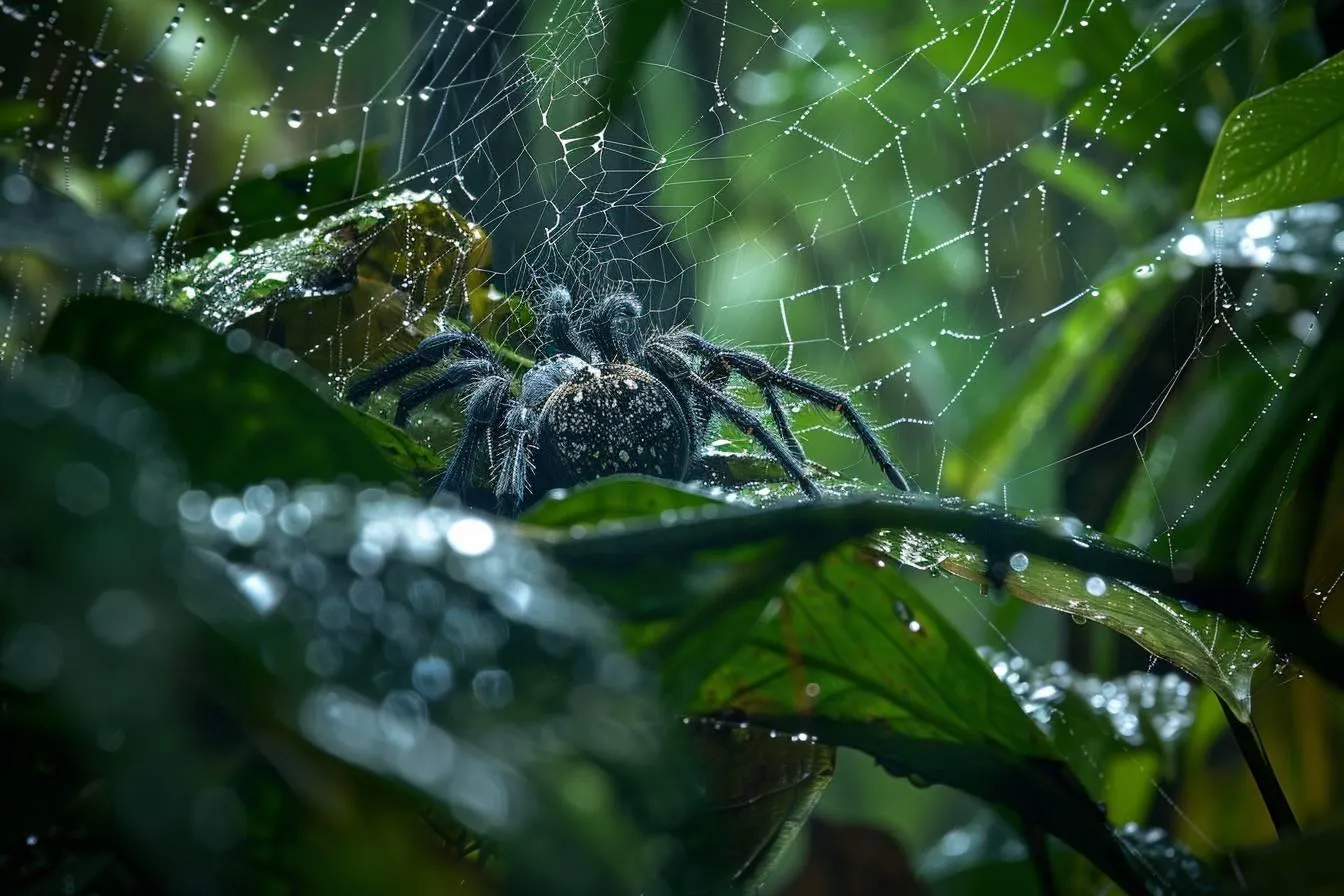
Selenocosmia javanensis and several Chilobrachys species live in burrows on the forest floor, mostly in protected areas like Bali Barat National Park. They’re nocturnal, shy, and effectively invisible unless you go looking for them on a guided night walk. Defensive bites are painful but not medically serious.
Crab Spiders and Garden Spiders
Thomisus crab spiders sit camouflaged inside flowers to ambush pollinators. Argiope appensa - the Hawaiian Garden Spider - builds the zigzag-patterned webs you’ll see across rice paddies, doing useful pest-control work in agricultural areas.
The One That Actually Matters: Brown Widow
The Brown Widow (Latrodectus geometricus) is an established non-native and the only species on the island whose bite is worth seeking medical attention for if symptoms escalate. Encounters are uncommon and it’s not aggressive - but it’s small, drab, and easy to miss, which is exactly the problem. More on this below.
What Is the Biggest Spider in Bali?
By leg span, it’s a close call between the Pantropical Huntsman (typically around 10 cm, with exceptional individuals occasionally larger (1)(4)) and the Javan Rustleg Tarantula (up to 16 cm). By sheer visual impact, the Giant Golden Orb-Weaver wins - its web can span several meters across forest clearings.
The huntsman is what you’ll actually encounter. Tarantulas stay in burrows in protected forest. Orb-weavers stay in their webs and want nothing to do with you.
Here’s what most guides get wrong: size in Bali doesn’t correlate with danger. The biggest spiders here are the least medically significant. The brown widow - small, drab, easy to overlook - is the only one whose bite occasionally requires antihistamines or a clinic visit.
Are There Dangerous Spiders in Bali?
No species in Bali is documented as life-threatening to healthy adults (4)(5). No pattern of hospital admissions from bites. Bite reactions in healthy adults are typically comparable to a wasp sting.
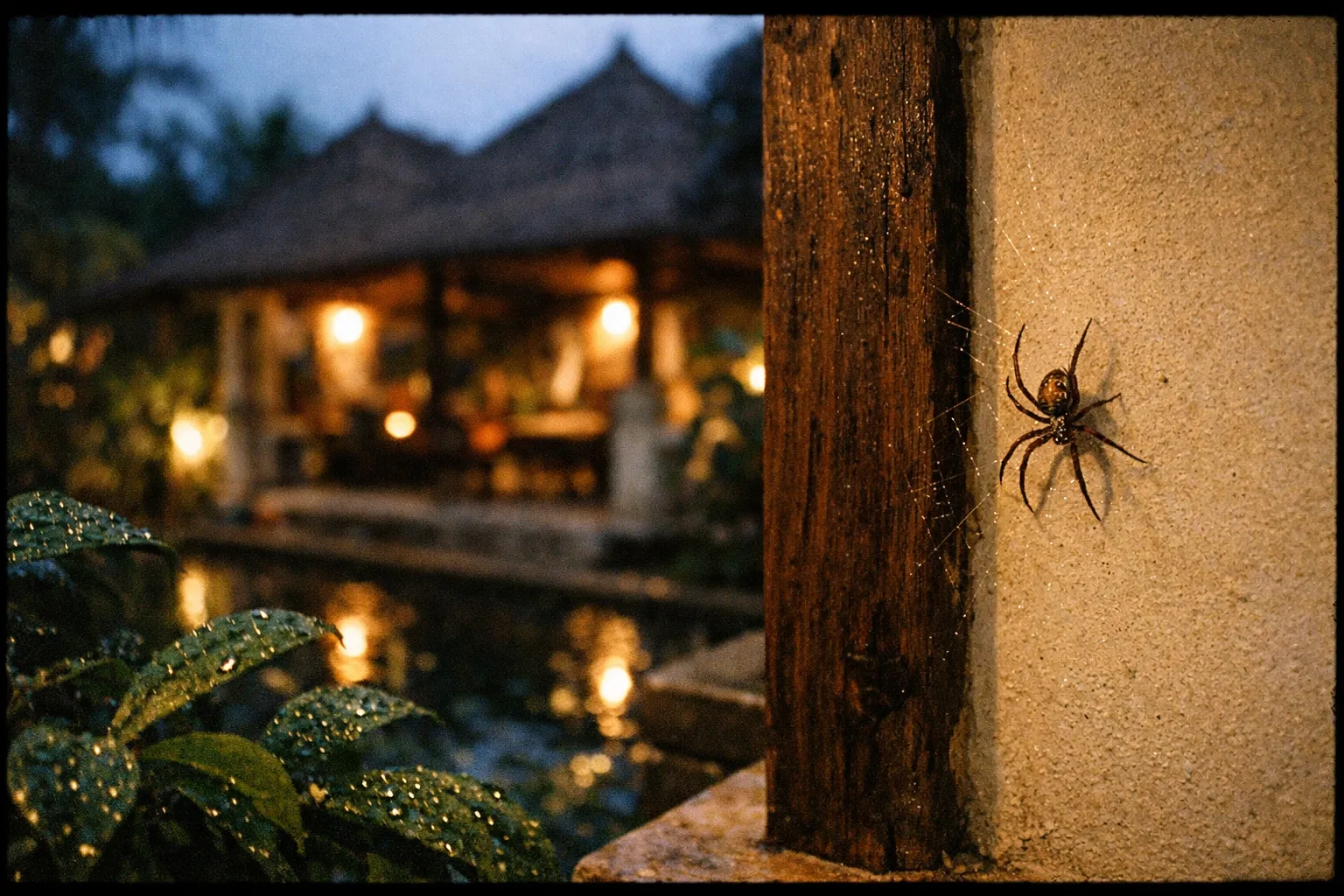
Travelers from Australia, the US, and parts of Europe arrive primed by media coverage of redbacks, funnel-webs, and brown recluses. None of those, or anything equivalent, lives in Bali.
What a typical bite looks like, per BaliVillaHub’s expat-focused reporting (5):
- Local redness and swelling at the bite site
- Mild itching or burning for a few hours
- Resolution within 24 to 48 hours with basic care
When to actually see a doctor:
- Swelling extends more than 10 cm from the bite
- Difficulty breathing, dizziness, or systemic symptoms
- Bite site shows signs of infection after 48 hours
- You’re certain it was a brown widow
Clinic costs in tourist areas run USD $20 to $60 for a consultation at neighborhood clinics in Canggu, Ubud, or Kuta. International hospitals like BIMC or Siloam charge $80 to $150. Oral antihistamines (cetirizine 10 mg) cost $1 to $5 per strip of 10 tablets at any apotek.
First-Aid Protocol for a Suspected Bite
First-Aid Protocol for a Suspected Spider Bite in Bali
30 minutesSteps to manage a spider bite safely and effectively
- 1
Wash the bite area
Use soap and water within 5 minutes of the bite to clean the site.
- 2
Apply a cold pack
Place a cold pack on the bite for 10 to 15 minutes to reduce swelling and pain.
- 3
Take an oral antihistamine
If itching is significant, take cetirizine or a similar antihistamine.
- 4
Photograph the spider
If safe, take a photo of the spider for identification at the clinic.
- 5
Monitor symptoms
Watch for worsening symptoms over 1 to 2 hours and seek medical help if needed.
What Is the Biggest Predator in Bali?
This question shows up in searches because people worried about bali spiders tend to worry about everything else on the island too. The honest answer: Bali has no apex land predator that threatens humans. The native Bali tiger was declared extinct in the 1940s. No bears, no large cats, no documented venomous snakes causing regular fatalities.
The largest predators you might realistically encounter:
- Reticulated pythons in rural and forested areas (non-venomous, ambush hunters of rodents and small mammals)
- Saltwater crocodiles are not established on Bali - they’re a concern in parts of Indonesia, but not here
- Long-tailed macaques in temple complexes - not predators of humans, but they bite, steal food, and are the most common cause of animal-related injuries to tourists
- Stray dogs - by far the highest practical risk; rabies is endemic and dog bites should always be treated immediately
Spiders, in this hierarchy, are nowhere. They prey on insects, occasionally small lizards, and that’s the end of the food chain for them.
Bali Spider Season: When Populations Peak
Spiders are present year-round, but visibility tracks the insect supply.
Peak season (high activity): November through April - the rainy season and the weeks immediately after. Insect populations surge, webs go up around every porch light, and orb-weaver webs rebuild overnight. Villa owners in this window report more frequent indoor encounters with huntsman and house spiders, particularly during the heaviest rain weeks (5).
Low season (lower visibility): June through September. Fewer flying insects means fewer webs at face height and less reason for spiders to congregate near lights and water sources. If you’re a serious arachnophobe planning a trip, this is your window.
The shoulder months - May and October - sit in between. Manageable but not minimal.
What this means in practice:
- A January villa stay in Canggu will involve some web-clearing in the garden
- A July beach trip to Nusa Dua will involve essentially zero spider awareness
- An August trek in Bali Barat will still show plenty of orb-weavers because rainforest microclimates hold humidity year-round
Where to Expect Spiders (and Where You Won’t)
High-Encounter Zones
Ubud and the central highlands - dense vegetation, traditional architecture, lots of open-air design. Orb-weavers in every garden, huntsman in many bathrooms. Worth the detour for naturalists; worth knowing about if you’re not.
Bali Barat National Park (west Bali) - the best place to actually look for tarantulas on a guided night walk. Park rangers run nocturnal tours using red headlamps to spot Chilobrachys species emerging from burrows. Budget USD $30 to $60 for a guided night session; book through the park office in Cekik or via Labuan Lalang. The park entrance at Cekik is open daily 07:30 to 17:00 for day permits; night-walk permits must be arranged in advance and are typically limited to groups of four or fewer - contact the Cekik office directly at least 48 hours ahead. If you’re coming from Seminyak or Ubud, factor in a 2.5 to 3-hour drive west on the Trans-Bali Highway; the road narrows significantly past Negara and is not recommended after dark without a local driver. One thing most guides skip: the park does not maintain an online booking system as of 2026, so email or WhatsApp the Cekik ranger station directly rather than booking through third-party tour aggregators, which often add 40 to 60% markup for the same walk.
Tegallalang Rice Terraces - early-morning orb-weaver webs strung across the terraces. Photogenic, not threatening.
Munduk - north-central, cooler, misty forests. A different microclimate produces species you won’t see in the south. Decent base for waterfall hikes that double as spider-spotting walks.
Nusa Penida - relatively undisturbed habitats off Bali’s southeast coast. Less developed means more diverse fauna, including spider species adapted to limestone and coastal scrub.
Low-Encounter Zones
- High-rise hotels in Kuta, Legian, Nusa Dua
- Air-conditioned apartments with sealed windows
- Sanur’s more developed beachfront
- New-build villas with monthly pest control
Choosing Accommodation by Spider Tolerance
If You’re Highly Arachnophobic
Book modern hotels or sealed-window apartments in dense urban beachfront zones. Kuta, Legian, central Seminyak, and Nusa Dua all work. Expect to pay 10 to 20% more than a basic homestay - roughly USD $40 to $80/night vs. $20 to $40 - but you’ll trade that for near-zero indoor encounters.
Avoid anything described as “open-plan,” “jungle villa,” or “alang-alang roof.” Garden bathrooms, outdoor showers, and rice-field locations in Canggu’s interior or Ubud’s outer villages all increase contact significantly.
If You’re Moderately Concerned
Managed villas at USD $80 to $150/night typically include monthly or bi-weekly pest control in the rental fee. When booking on Airbnb or Booking.com, message the host directly and ask: Is pest control done monthly? Are bedrooms fully enclosed? Are windows screened? A yes on all three puts you in low-encounter territory even in lush areas.
If You’re Tolerant or Curious
Eco-lodges in Ubud, Sidemen, and north Bali (USD $40 to $120/night) put you inside the ecosystem. Expect garden orb-weavers, occasional indoor huntsman, and staff who’ll relocate anything that bothers you. This is the right choice if you want to see bali spiders, not avoid them.
Practical Encounter Management
Daily Habits in Any Villa
- Shake out shoes before putting them on (a 3-second check that becomes automatic by day two)
- Glance at bathroom corners and the ceiling before showering
- Don’t leave damp towels piled on the floor overnight
- Keep luggage zipped when not in use
Total time investment: under 5 minutes a day.
Weekly Maintenance
Sweep webs from outdoor living areas and garden paths between 6 and 8 am, when orb-weavers are least active. A long-handled broom works fine. Webs will rebuild overnight - this just prevents face-level encounters on the way to breakfast.
Reducing the Insect Supply
Spiders are downstream of insects. Cut the insect supply and the spiders go elsewhere.
- Turn off porch and garden lights overnight, or switch to yellow “bug” bulbs
- Use mosquito nets over beds (USD $15 to $40 at local home stores)
- Run AC and keep windows shut at night where possible
- Install door sweeps if your villa has gaps under doors
If You Need Chemical Control
DIY aerosol sprays - Baygon, Hit, or local brands like Bagus - cost USD $2 to $5 per can at any minimart. Effective for indoor spot treatment but environmentally heavy if used routinely. Professional pest control for a 2 to 3 bedroom villa in Canggu or Seminyak runs USD $30 to $80 per monthly treatment based on 2024 local provider quotes. For stays over a month, that’s usually the better option.
Handling a Huntsman Without Panicking
- Turn on all the lights - they prefer dark cover
- Open a door or large window to the outside
- Hold a soft broom between you and the spider
- Gently guide it toward the opening
- It will usually be outside within 2 to 3 minutes
Crushing them on walls leaves stains and doesn’t reduce the insect population that drew them in.
Gear for Spider-Aware Travel
Worth packing or buying on arrival:
- Headlamp (USD $10 to $30 at outdoor stores or online) - essential for night walks in rural areas and for spotting webs before you walk into them
- Closed trainers (USD $20 to $40 in Bali) - for trekking and any after-dark garden walking
- Lightweight trekking pants (USD $8 to $15 at local markets) - useful for jungle trails where brush contact is constant
- Cetirizine 10 mg - pack from home or buy at any apotek for $1 to $5
Skip if short on time: macro photography lenses unless you’re specifically here for arachnid photography. The big spiders in Bali are large enough for a standard phone camera.
Cultural Context: Spiders in Balinese Tradition
Spiders carry symbolic weight in Balinese folklore as figures of patience and creativity, and their webs appear in traditional art as metaphors for the connections that hold life together. Local farmers in the rice belt around Tegallalang sometimes describe spiders as teachers - slow, deliberate creatures that build something complex from a single thread. Worth asking your guide about during a rice-terrace walk. It adds context to what otherwise looks like just another web.
Conservation and the Role of Spiders in Bali’s Ecosystem
Spiders do unglamorous but important work here. Orb-weavers and jumping spiders eat the insects that would otherwise damage rice crops, reducing pesticide demand. They feed birds, geckos, and small mammals across the island. Healthy spider populations also function as indicator species - where they thrive, the broader ecosystem is generally intact.
Threats include habitat loss from villa development, pesticide overuse, and climate-driven shifts in rainfall patterns. The practical takeaway for travelers: choose accommodations that retain green space, avoid demanding heavy chemical pest control where it isn’t needed, and consider logging observations to iNaturalist during your stay. Bali’s records on the platform are still thin, and visitor data genuinely helps.
Spider-Watching as a Deliberate Activity
If you want to go looking rather than avoid:
Bali Barat National Park - book a guided night walk through the park office. Best for tarantulas and nocturnal hunters. USD $30 to $60 per session.
Ubud Monkey Forest - early morning, before the crowds arrive. Orb-weaver webs at their best with dew still on them. Free with park entry.
Tegallalang Rice Terraces - golden-hour photography of garden spiders and orb-weavers. Entry fee is small (around IDR 25,000, or $1.50).
Nusa Penida - for serious enthusiasts willing to take the morning fast boat from Sanur. Less-studied populations, possible endemics in the limestone interior.
Bring a headlamp with a red filter, the iNaturalist app, and patience. Most spider activity happens just after sunset and again in the pre-dawn hours.
Frequently Asked Questions
- Are spiders a problem in Bali?
- Most travelers experience minimal issues with spiders in Bali. Encounters depend heavily on accommodation type and location, with urban hotels reporting few sightings and rural villas seeing more. The spiders present are generally harmless, causing bite reactions similar to wasp stings.
- What is the biggest spider in Bali?
- The Pantropical Huntsman is the largest commonly encountered spider with a leg span of 12 to 15 cm. The Javan Rustleg Tarantula can reach up to 16 cm but is rarely seen. The Giant Golden Orb-Weaver creates the largest webs but is not dangerous.
- What types of spiders are in Bali?
- Bali hosts thousands of arachnid species, but travelers typically encounter a handful of recognizable types including orb-weavers, huntsman spiders, jumping spiders, wolf spiders, crab spiders, and tarantulas in protected forests.
- What is the biggest predator in Bali?
- Bali has no apex land predators threatening humans. Reticulated pythons are the largest snakes present but are non-venomous. Macaques and stray dogs pose more risk to tourists than spiders or snakes.
- When is Bali spider season?
- Spider activity peaks during the rainy season from November through April due to increased insect populations. The dry season from June through September sees fewer spiders and is the best time for arachnophobes to visit.
- Are there dangerous spiders in Bali for tourists?
- No spider species in Bali is known to be life-threatening to healthy adults. The brown widow is the only species whose bite may require medical attention, but encounters are rare and it is not aggressive.
- What should I do if a spider bites me in Bali?
- Clean the bite with soap and water, apply a cold pack, and take an antihistamine if needed. Photograph the spider if possible. Seek medical care if swelling spreads significantly, breathing difficulties occur, or signs of infection develop.
The short version: bali spiders are interesting, occasionally large, and almost entirely harmless. Pick accommodation that matches your tolerance, time your visit if you’re sensitive to the peak insect months, keep your shoes shaken out, and learn to herd a huntsman with a broom. The actual risk is low enough that it shouldn’t shape your itinerary - but knowing what’s on the wall and why beats finding out at 2 am.