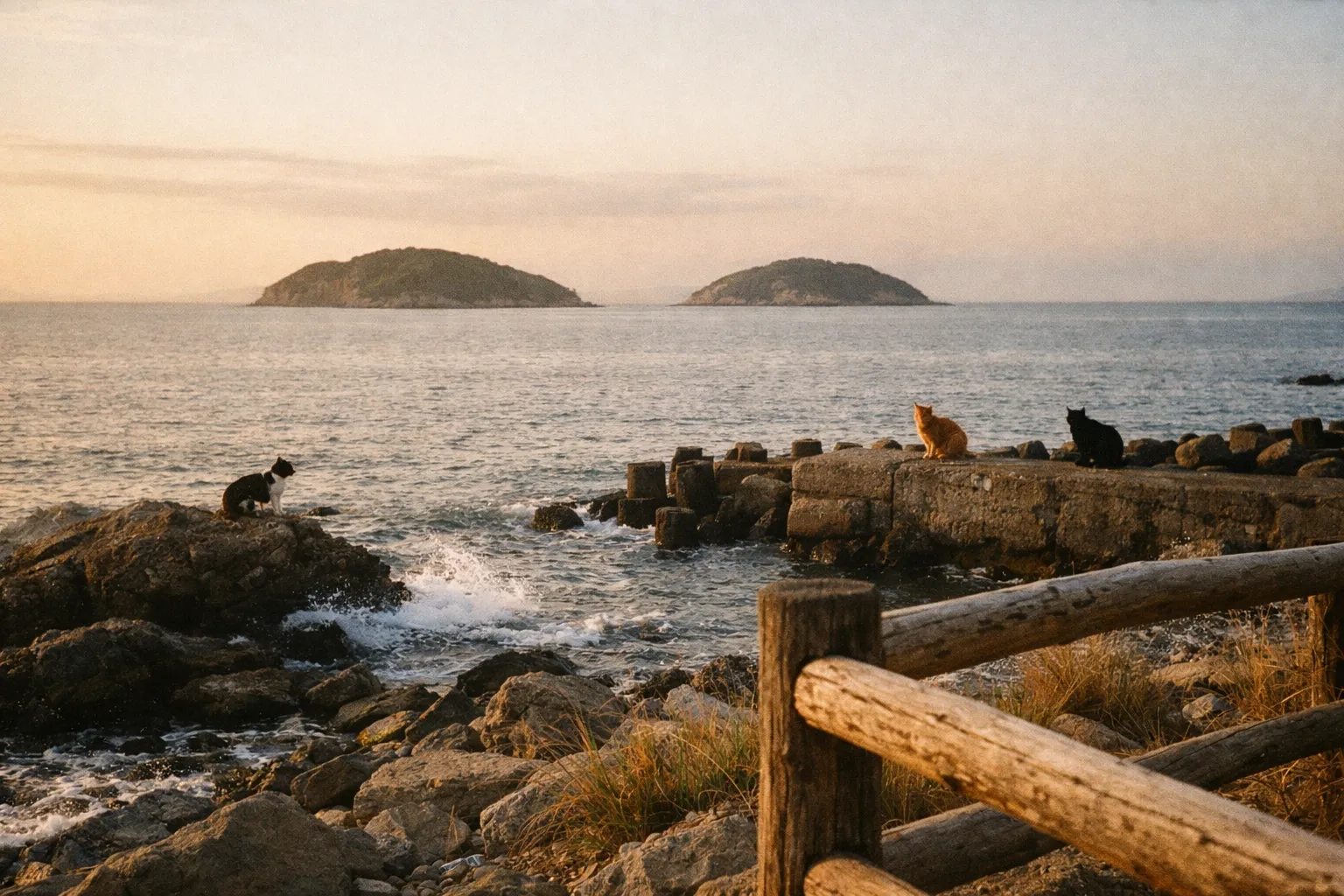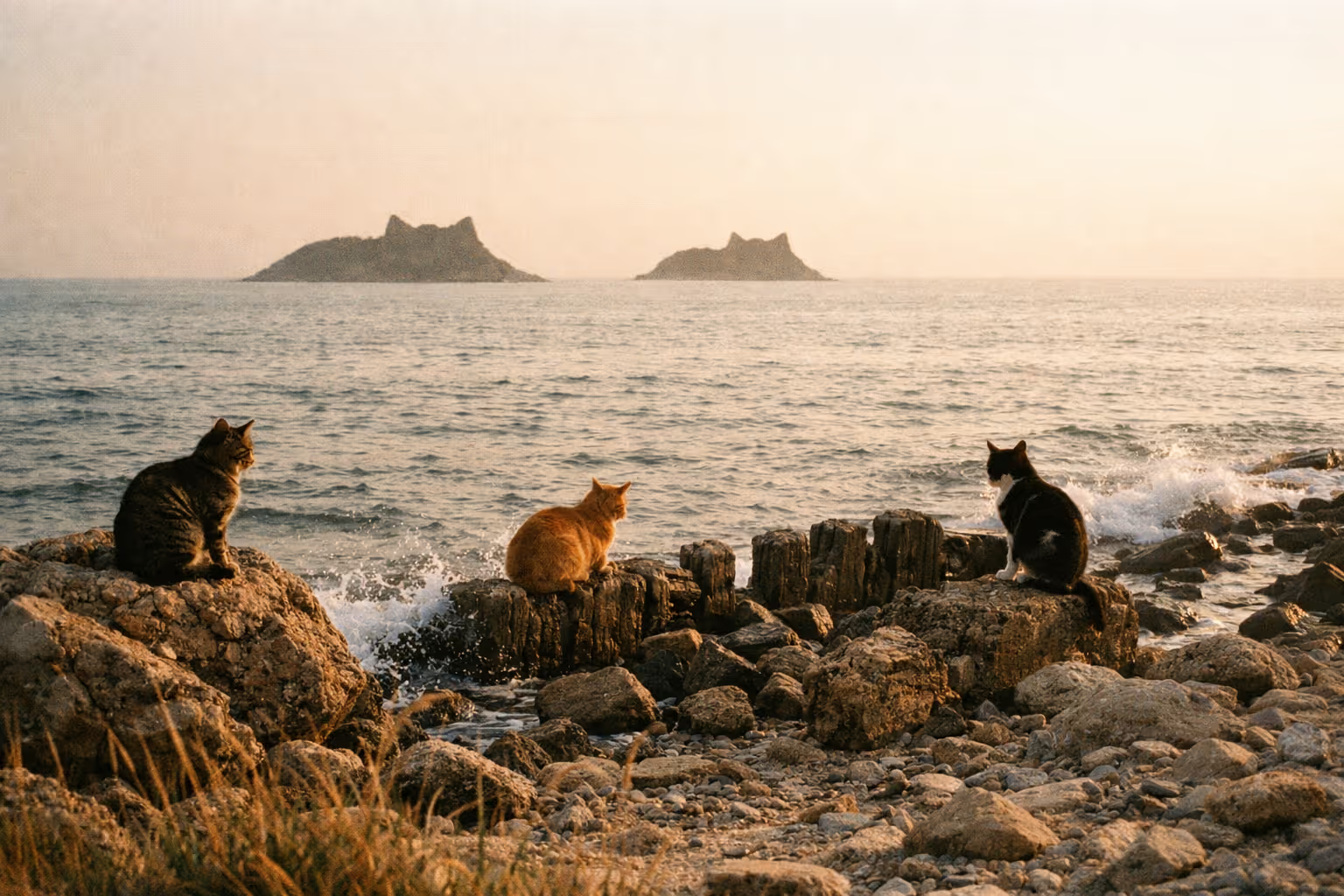
Where is Cat Island Japan, and which one should you visit?
Cat Island Japan - most commonly referring to Tashirojima cat island in Miyagi Prefecture or Aoshima in Ehime - is best known for two main islands where cats outnumber humans: Aoshima and Tashirojima. Aoshima sits in the Uwa Sea area off Nagahama Port in Ehime Prefecture, on the island of Shikoku. Closest major city is Matsuyama - population around 510,000, with a domestic airport and a JR line running down to Iyo-Nagahama. The island is small enough to walk end-to-end in under 30 minutes. No shops, no restaurants, no vending machines, no accommodation (3).
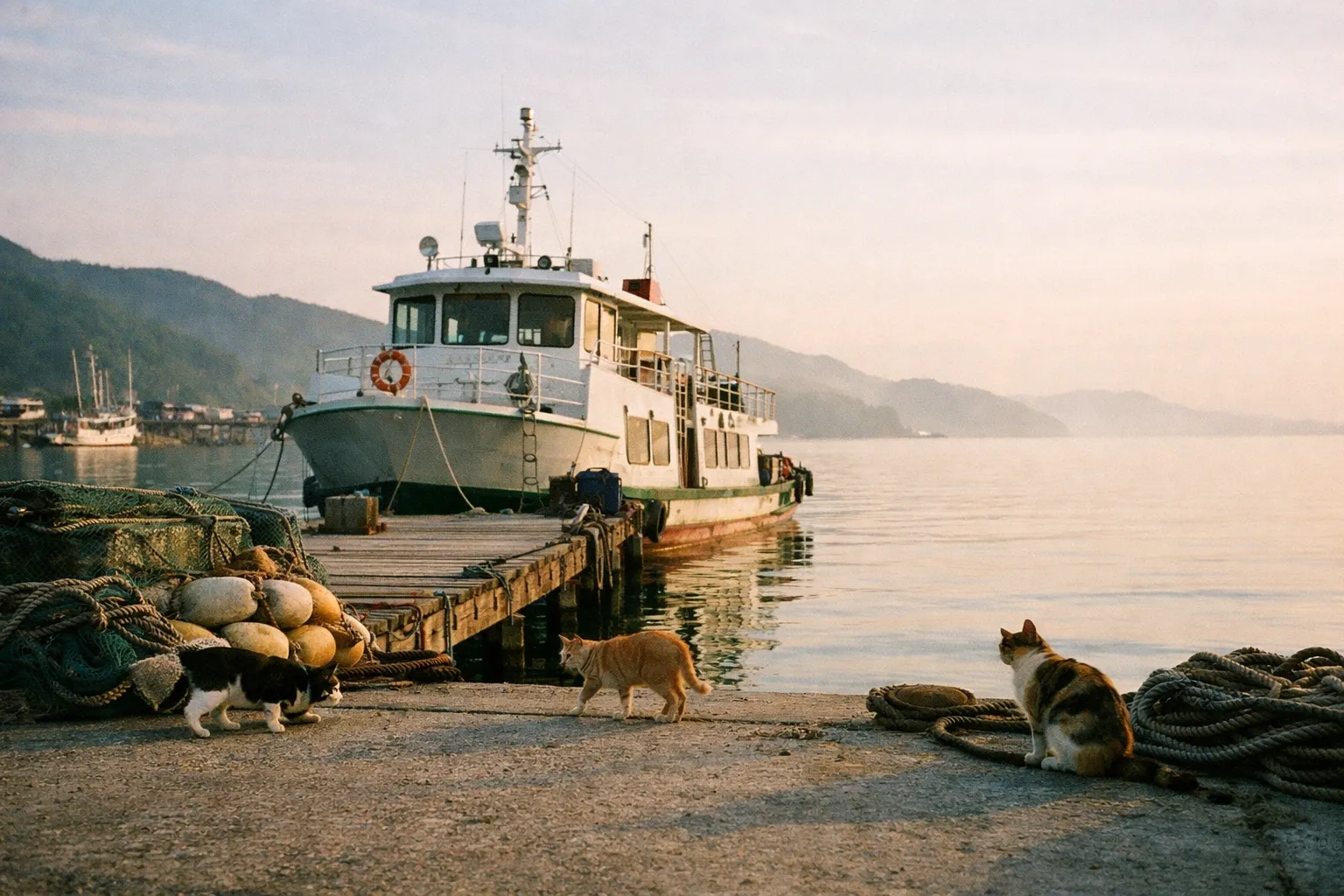
Tashirojima sits in the Pacific off Ishinomaki in Miyagi Prefecture, roughly 90 minutes north of Tokyo by shinkansen plus a transfer. It covers about 3.14 km² and has two ports: Nitoda (the main village, where most cats concentrate) and Odomari (smaller, noticeably fewer cats). There’s a cat shrine - Neko-jinja - on the trail between them, plus manga-themed cabins at the Manga Island campground (4).
Quick decision framework:
- Pick Tashirojima if you’re based in or near Tokyo, want overnight options, or want the cat shrine and manga lodgings. It’s the more forgiving trip.
- Pick Aoshima if you’re already in Shikoku or doing a Setouchi circuit, want the smaller “abandoned village with cats” atmosphere, and are comfortable bringing all your own food and water.
- Skip both if you’re expecting cats blanketing every surface. Both islands have aging cat populations and the animals spread out - especially in hot or wet weather.
The Setouchi region also markets several other cat-adjacent islands - Manabeshima, Sanagishima, Ogijima, Iwaishima, Muzukijima - if you’re building a longer multi-island trip (5). Enoshima near Kamakura sometimes shows up in cat island lists too (6), but it’s a mainstream day-trip destination with a stray cat community, not a dedicated cat island.
How to Get to Tashirojima (the easier option from Tokyo)
The route from Tokyo: Tokyo → Sendai → Ishinomaki → Ajishima Line ferry → Nitoda or Odomari.
Transport breakdown:
- Tohoku Shinkansen, Tokyo to Sendai - 90 to 100 minutes. Unreserved seat around ¥10,890 one way (~USD $73 at ¥150/USD).
- JR Senseki Line, Sendai to Ishinomaki - 60 to 90 minutes, around ¥860 one way (~USD $6).
- Bus or taxi from JR Ishinomaki to the Ajishima Line ferry terminal - 10 to 15 minutes. Bus ¥200-¥300, taxi ¥1,000-¥1,500.
- Ajishima Line ferry to Tashirojima - about 40 minutes to Nitoda. Round-trip typically ¥2,500-¥3,000 (~USD $17-$22), with two to three round trips per day (7)(8).
Total transport from Tokyo runs roughly ¥27,000-¥30,000 round trip per person (~USD $180-$200), with about 3 hours of one-way travel time.
Booking mechanics: Ajishima Line tickets are bought at the port the day of travel, cash preferred. Check the operator’s website the night before - sailings get canceled for wind and rough seas with little notice, and cancellation notices are often posted in Japanese only. If you don’t read Japanese, paste the URL into Google Translate before you board the shinkansen. I’ve seen people show up at Ishinomaki after a 3-hour trip from Tokyo only to find the morning crossing canceled with no English signage explaining why.
How to Get to Aoshima (the harder option, from Matsuyama)
From Tokyo, the route is: Tokyo → Matsuyama (flight) → Iyo-Nagahama (JR) → Aoshima ferry.
Transport breakdown:
- Domestic flight, Tokyo to Matsuyama - about 90 minutes. One-way fares run ¥10,000-¥25,000 (~USD $67-$167) depending on airline and advance booking.
- JR Yosan Line, Matsuyama to Iyo-Nagahama - 60 to 90 minutes, about ¥1,000-¥1,500 one way.
- Aoshima ferry from Nagahama Port - 35 minutes each way. Round-trip ¥1,360 (~USD $9) (9). Only two round trips per day, capacity around 30 to 40 passengers, tickets sold same-day at the port.
The Aoshima ferry is the bottleneck. On weekends, holidays, and during Golden Week or Obon, it sells out. Show up at least an hour before departure. Miss the only afternoon return and you’re stranded - there’s no lodging on the island.
Aoshima is worth the detour only if you’re already in Shikoku or doing a Setouchi multi-island trip. As a standalone destination from Tokyo, it costs more time and money than Tashirojima and offers less infrastructure. Tashirojima is the better default.
Population Dynamics: How Cats Took Over
Aoshima’s human population peaked around 800 in the 1940s. Today it’s in the single digits, almost entirely residents over 60 (10)(11). Cats were originally brought in to control rodents on fishing boats, thrived in the absence of predators, and now outnumber humans at a ratio of 10:1 or higher (12). Exact counts shift year to year - there’s no formal census, and the cat population has likely dipped slightly from its mid-2010s peak due to aging and limited spay/neuter programs (13).
Tashirojima follows a similar pattern but at a different scale. About 100 residents, most over 60, share the island with several hundred semi-wild cats (14). The Japan National Tourism Organization frames this as “25 percent humans, 75 percent cats” (15). The historical hook is silkworms - Tashirojima used to raise them, and cats kept mice away from the cocoons. Fishermen later considered cats lucky and fed them scraps, which is the origin of Neko-jinja: a small shrine to a cat killed by falling rocks (16)(17)(18).
The cats are community-fed rather than owned. They’re used to humans but not domesticated in the housecat sense - they tolerate proximity, will accept treats, and generally don’t want to be picked up.
What It Actually Costs
Realistic per-person totals for a day trip, excluding lodging in the gateway city. Conversions at ¥150/USD.
Tashirojima day trip from Sendai:
- Round-trip JR Senseki Line: ~¥1,720
- Bus/taxi to ferry: ~¥600
- Round-trip Ajishima ferry: ~¥2,500-¥3,000
- Food, water, cat treats: ~¥1,500-¥2,500
- Total: ¥6,300-¥9,800 (USD $42-$65)
Aoshima day trip from Matsuyama:
- Round-trip JR Yosan Line: ~¥2,000-¥3,000
- Round-trip Aoshima ferry: ¥1,360
- Food, water, cat treats (must bring everything): ~¥1,500-¥2,500
- Total: ¥4,860-¥6,860 (USD $32-$46)
If you’re starting from Tokyo, add the shinkansen to Sendai (~¥21,780 round trip) or the flight to Matsuyama (~¥20,000-¥50,000 round trip). For multi-day Setouchi circuits combining Aoshima with Naoshima, Ogijima, or Manabeshima, budget ¥20,000-¥40,000 in inter-island transport over 4 to 7 days.
When to Visit
April through June and September through early November are the strongest windows. Mild temperatures, more predictable seas, fewer ferry cancellations, and better light. Cats are more active and visible in cooler weather - in July and August heat they disappear into shade and under buildings, which is exactly when most tourists show up.
Winter works for Tashirojima, but expect some cats to stay sheltered and rough seas to cancel ferries more often. Aoshima ferries get canceled regularly in winter wind.
Avoid Golden Week (late April to early May), Obon (mid-August), and New Year unless you book lodging months ahead. Manga Island cabins on Tashirojima are limited in number and fill up fast.
What to Pack
For Aoshima especially, treat this like a day hike with no resupply point:
- 1.5 to 2 liters of water per person
- Bento or convenience-store lunch (no shops on Aoshima)
- Cat treats - Ciao Churu tubes are the standard, ¥80-¥120 each at any Lawson or FamilyMart
- Hand sanitizer and wipes
- Cash in small bills and coins, at least ¥5,000-¥10,000 - ferries and any local shops are cash-only
- Sun hat, SPF 30+ sunscreen, light rain jacket
- Portable phone charger
- Translation app downloaded offline
For Tashirojima you can buy a few basics near the ports, but selection is limited. Bring food and water from Ishinomaki to be safe.
Cat Etiquette and Welfare
A few rules that come up repeatedly on local signage and in animal welfare guidance:
- No dogs on Tashirojima. This is an explicit island rule (19).
- Don’t pick up cats. They’re semi-wild. Let them approach you.
- Don’t overfeed. Small portions of appropriate treats, not piles of human food. No milk, no spicy or salty snacks.
- Don’t feed near the ferry terminal exits. Some operators have asked visitors to spread food distribution out so cats don’t crowd boarding areas.
- Pack out your trash. Bins are minimal on both islands.
- Keep noise down near homes. These are still functioning villages, mostly elderly residents.
A couple of useful phrases: Sawatte mo ii desu ka? (May I touch?) and Era wa ii desu ka? (Is feeding okay?).
What Most Guides Get Wrong About Cat Island Japan
Most cat island content was written between 2015 and 2018, when populations were at their peak and social media first amplified these destinations. Several things have shifted since.
Cat density is lower than the viral videos suggest. Tashirojima cats spread across the island - you won’t see hundreds in one spot. Nitoda has the highest concentration, Odomari has very few (20).
Aoshima is not always full of cats. Recent visitors report quieter days, especially in midday heat. The “abandoned village with cats” framing is more accurate than any version of “cat paradise.”
There is no tourist infrastructure on Aoshima. Some older guides imply you can grab food on the island. You cannot. No shops, no restaurants, no vending machines (21).
Ferries do get canceled. Older content treats schedules as fixed. They’re not - especially in winter and during typhoon season.
If you go in expecting a quiet, rural Japan experience with a high concentration of cats in specific spots, you’ll have a good day. If you go in expecting a feline theme park, you’ll leave disappointed.
Tashirojima is the more practical cat island from Tokyo - better ferry reliability, overnight options, and a cat shrine worth the detour. Aoshima rewards visitors already in Shikoku who want a quieter, more stripped-back experience, but the two-ferry-per-day schedule and zero on-island infrastructure make it unforgiving for first-timers.
✓ Pros
- Tashirojima has overnight accommodation (manga cabins, minshuku) and a cat shrine - more to do per day
- Both islands offer a genuinely quiet, off-the-beaten-path rural Japan experience
- April-June and September-November give good cat visibility and mild weather
- Tashirojima is accessible from Tokyo as a long day trip or overnight without a flight
✗ Cons
- Aoshima has zero food, water, or accommodation on the island - full self-sufficiency required
- Ferry cancellations are common on both islands, especially in winter and typhoon season
- Cat density is lower than viral photos suggest - animals spread out and hide in heat
- Aoshima from Tokyo costs more time and money than Tashirojima with less infrastructure payoff
Where to Stay Overnight on Tashirojima
Day trips work for both islands, but Tashirojima has overnight options if you want early-morning or late-afternoon light without the day-tripper crowds.
- Manga Island cabins at the campground - themed, small in number, ¥6,000-¥10,000 per person per night with basic bedding. Book months ahead for weekends and holidays (22).
- Local minshuku (family-run guesthouses) in Nitoda - limited but available, usually arranged by phone in Japanese.
For gateway cities, business hotel chains like Toyoko Inn and APA Hotel run ¥5,000-¥8,000 per night in Sendai or Matsuyama. Both have solid rail and airport connections.
Is Cat Island Japan Worth Visiting?
Worth it if: you genuinely like cats, you enjoy quiet rural Japan, you’re already in the region (Tohoku for Tashirojima, Shikoku for Aoshima), and you treat it as a half-day or full-day excursion rather than the centerpiece of your trip. Tashirojima cat island in particular suits travelers who want a structured day - ferry to Nitoda, walk the trail to Neko-jinja, loop back through Odomari, catch the afternoon return crossing. That’s a full 6-7 hours without feeling rushed.
Not worth it if: you’re coming all the way from Tokyo just for Aoshima (the transport math doesn’t work), you expect a high-density photo opportunity, or you have mobility limits - village roads are uneven and there’s no transport on either island. Aoshima’s two-ferry-per-day schedule leaves almost no margin for error; one missed boat and you’re sleeping on a bench with no food.
For most travelers, Tashirojima from Sendai is the better choice. Accessible from Tokyo as a long day trip or overnight, actual lodging, the cat shrine and manga cabins, and a ferry that runs more reliably than Aoshima’s. The round-trip from Tokyo runs USD $180-$200 in transport - steep for a day trip, but manageable if you fold it into a broader Tohoku itinerary.
Does Anyone Live on Cat Island Japan?
Yes, but the numbers are small and still shrinking. Aoshima has fewer than 10 permanent residents, almost all over 60 (23). Tashirojima has about 100 residents, also majority elderly (24)(25). On both islands, traditional fishing has declined and tourism provides some supplementary income - but the populations continue to age without meaningful replacement.
This matters for how you behave as a visitor. These aren’t tourist attractions staffed by guides. They’re functioning villages with very few people. Keep noise levels low, don’t enter private property, and recognize that residents have a complicated relationship with cat tourism - it brings money, but also trash, foot traffic, and strangers.
Who Feeds the Cats?
Primarily the local residents, supplemented by volunteers and visitors who bring supplies on the ferry. On Tashirojima, fishermen have historically fed cats fish scraps - a tradition that continues in modified form (26)(27). On Aoshima, elderly residents have organized basic feeding routines, with occasional outside volunteer support. With Aoshima’s human population in the single digits, that feeding responsibility falls on very few people - which is worth keeping in mind when you show up with a bag of Churu tubes and 40 other day-trippers do the same.
Visitor-brought treats are welcomed, but the welfare picture is mixed. Spay and neuter rates have historically been low, which is part of why populations grew so fast in the first place. Some recent initiatives have started addressing this on both islands, but there’s no comprehensive program in place. If you want to contribute beyond treats, a few Japanese animal welfare organizations accept donations earmarked for island cat populations - search for current options before your trip rather than trying to hand over cash on-site. The cat population on both islands has likely declined slightly from its mid-2010s peak, and without structured intervention that trend is unlikely to reverse.
The broader point: cat island japan content online skews heavily toward the 2015-2018 boom years. The islands are quieter now, the cat counts are lower, and the human populations are older. That’s not a reason to skip them - it’s a reason to calibrate expectations before you board the ferry.
Final Logistics Check Before You Go
- Verify ferry schedules on the operator website 24 hours before departure
- Carry cash - ¥10,000 minimum per person
- Bring food and water, especially for Aoshima
- Download Google Translate offline for Japanese
- Build in a buffer day in case ferries cancel
- Don’t bring a dog to Tashirojima
- Don’t plan to overnight on Aoshima - there’s nowhere to sleep
The cat islands don’t reward loose planning. Get the ferry timing right, bring your own supplies, and you’ll have a quiet, slightly strange day in a part of Japan that doesn’t appear in most itineraries. That’s the actual value here - not the cat count.
Frequently Asked Questions
- Can I buy food or water on Aoshima?
- No. Aoshima has no shops, restaurants, or vending machines. Visitors must bring all food and water with them.
- How reliable are the ferry services to the cat islands?
- Ferries often get canceled due to wind, rough seas, or winter weather. Check the operator's website the night before and build in a buffer day.
- Are the cats on the islands friendly and domesticated?
- The cats are semi-wild; they tolerate human presence and accept treats but generally do not want to be picked up.
- Is it possible to stay overnight on Aoshima?
- No. Aoshima has no accommodation. Missing the last ferry means being stranded until the next day.
- What is the best time of year to visit for cat visibility?
- Spring (April-June) and autumn (September to early November) offer mild weather and more active cats. Summer heat causes cats to hide.
- Are there any restrictions on bringing pets to the islands?
- Dogs are not allowed on Tashirojima as per island rules.
- How do locals manage the cat populations?
- Local residents primarily feed the cats, supplemented by visitors. Spay/neuter programs are limited but some initiatives exist.