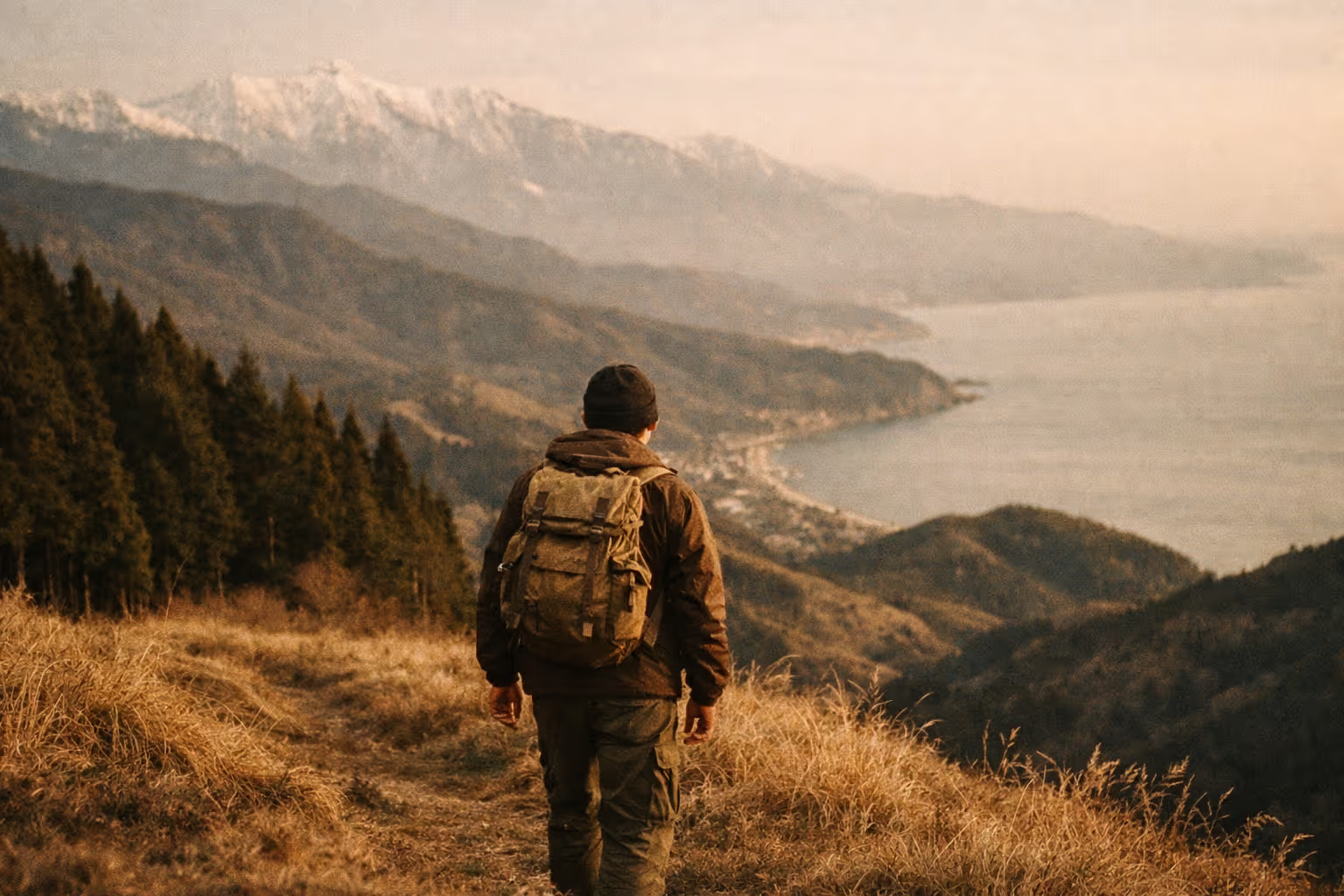
Does Japan have good hiking? Trails by region
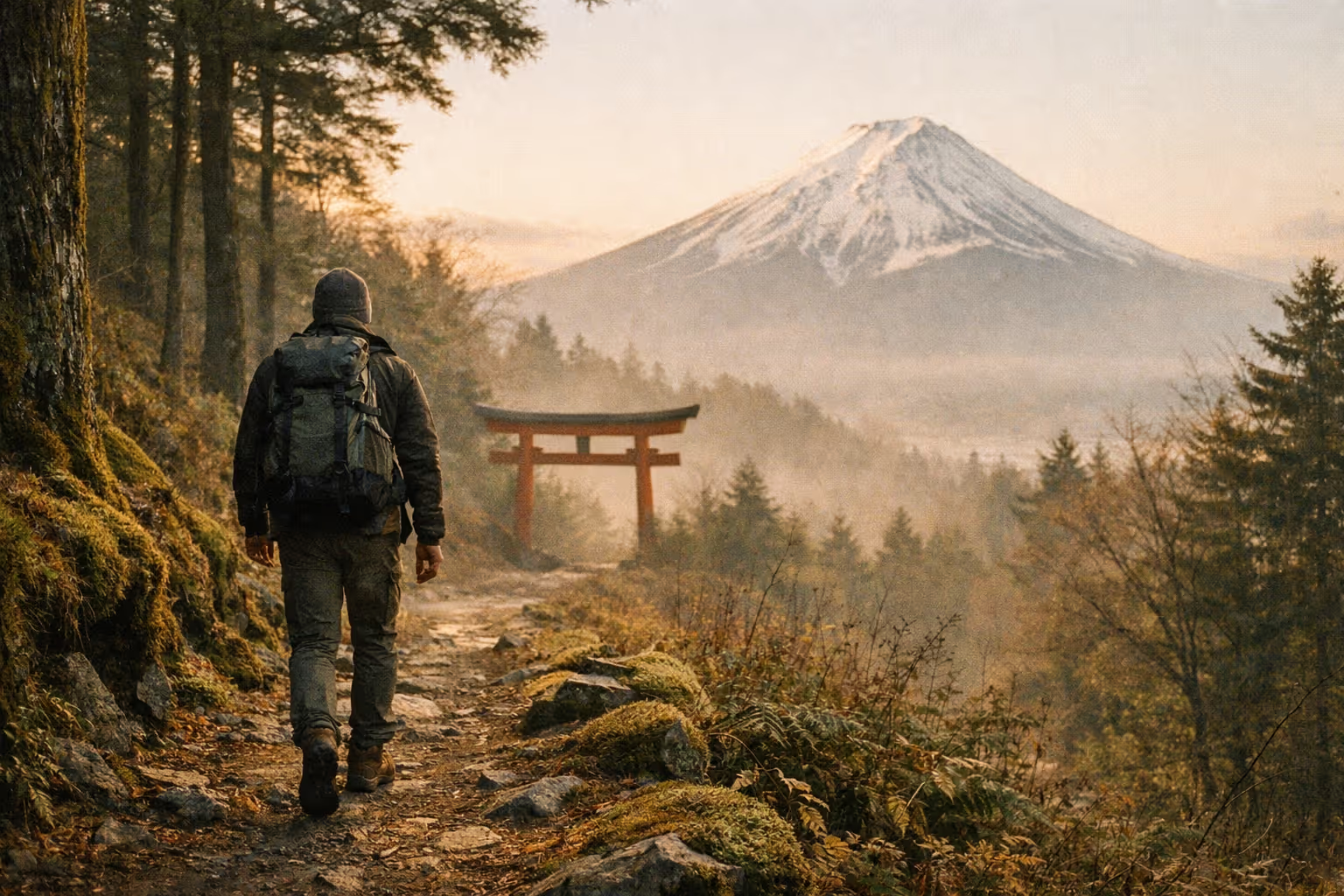
Short answer: yes, and it’s some of the most varied hiking in Asia. Japan’s official tourism resources describe “abundant hiking opportunities” running from beginner forest trails to demanding alpine traverses (6). Here’s how the regions break down.
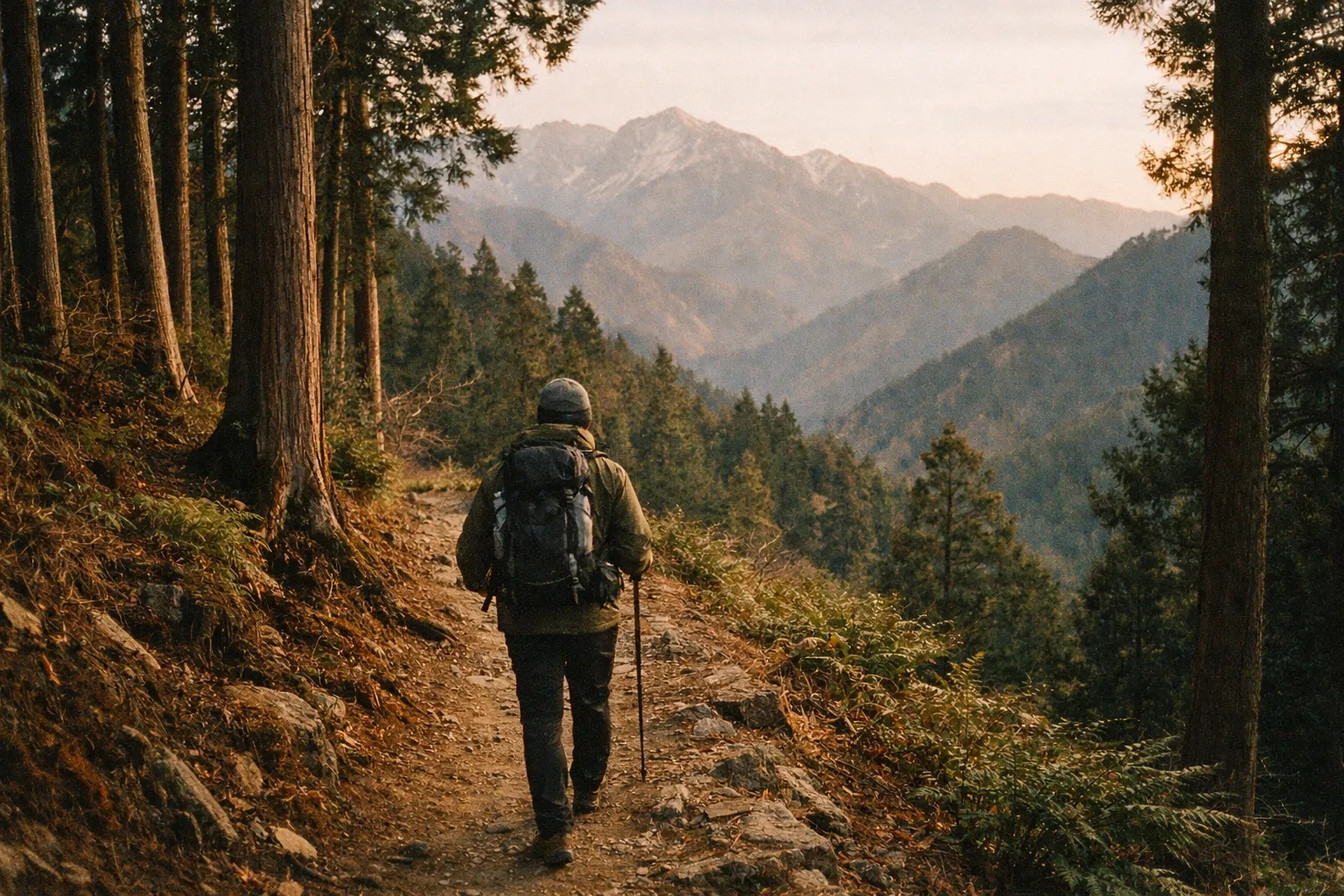
- The Japanese Alps (Chūbu region): The headline act. Granite ridgelines, mountain huts every few hours, and peaks like Yarigatake and Okuhotakadake. Best for intermediate to advanced hikers from July to September.
- Hokkaido: hiking in Hokkaido Japan centers on Daisetsuzan National Park - wide volcanic plateaus, fumaroles venting steam, and Japan’s earliest autumn colors (mid-September). Cooler, wilder, and home to brown bears.
- Mount Fuji: The country’s most climbed peak. Open roughly July through early September, with the Yoshida Trail as the beginner-friendly default.
- Yakushima: A subtropical island off Kyushu with thousand-year-old cedars, moss valleys, and high ridgelines. Wet, green, and excellent for a 3-day traverse.
- Kumano Kodo: A network of pilgrimage routes in Wakayama Prefecture - one of only two UNESCO-listed pilgrimage routes in the world. This is the “famous walk” most people mean when they ask about Japan.
The best hiking in Japan depends entirely on what you want: alpine drama, volcanic strangeness, ancient cedar, or a walk through history with a hot bath and dinner waiting each night.
Best time for hiking in Japan
The best time for hiking in Japan is generally late spring through autumn, but it varies sharply by region and altitude.
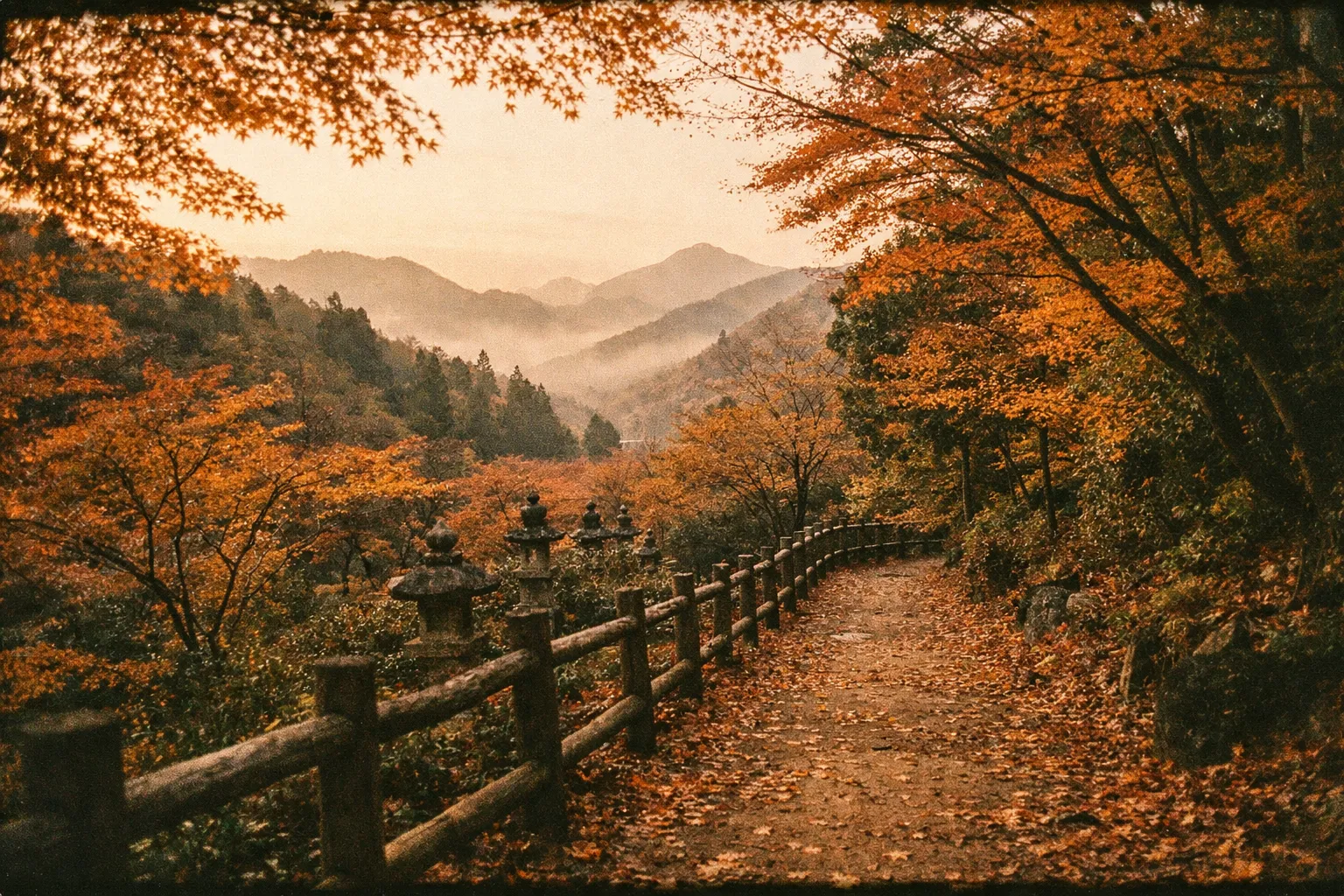
- Spring (April-May): Lower trails and historic footpaths like the Nakasendo come alive. High alpine routes are still buried in snow.
- Summer (July-September): The only window for the high Alps and Mount Fuji. Huts are open, buses run, but trails are busy and afternoon thunderstorms are common.
- Autumn (late September-November): The best all-rounder. Cooler air, clear skies, and koyo (autumn foliage) sweeping south from Hokkaido. Daisetsuzan peaks in mid-September; the Alps and Kyoto-area hills follow into November.
- Winter (December-March): A specialist season. Beautiful, but it demands avalanche awareness and full winter kit (see below).
Mount Fuji’s official climbing season runs July to early September, and the huts and bus services only operate within that window.
What to know before hiking in winter
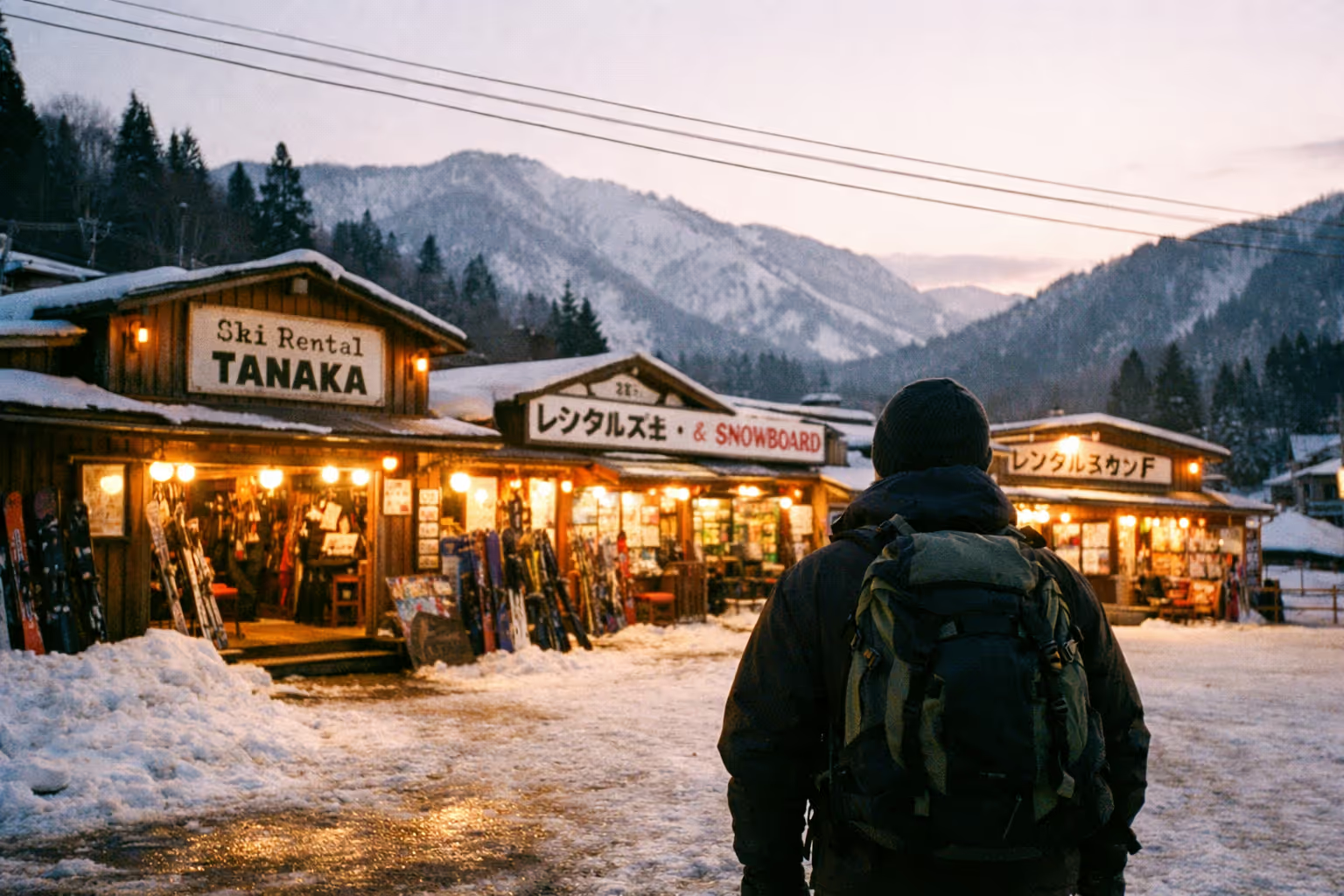
Japan’s mountains in winter look extraordinary - snow-loaded cedar branches, frozen waterfalls, ridge views that stretch for hundreds of kilometers on a clear day. I’ve hiked sections of the Japanese Alps in late February, and the visual payoff is real. So is the risk if you’re underprepared.
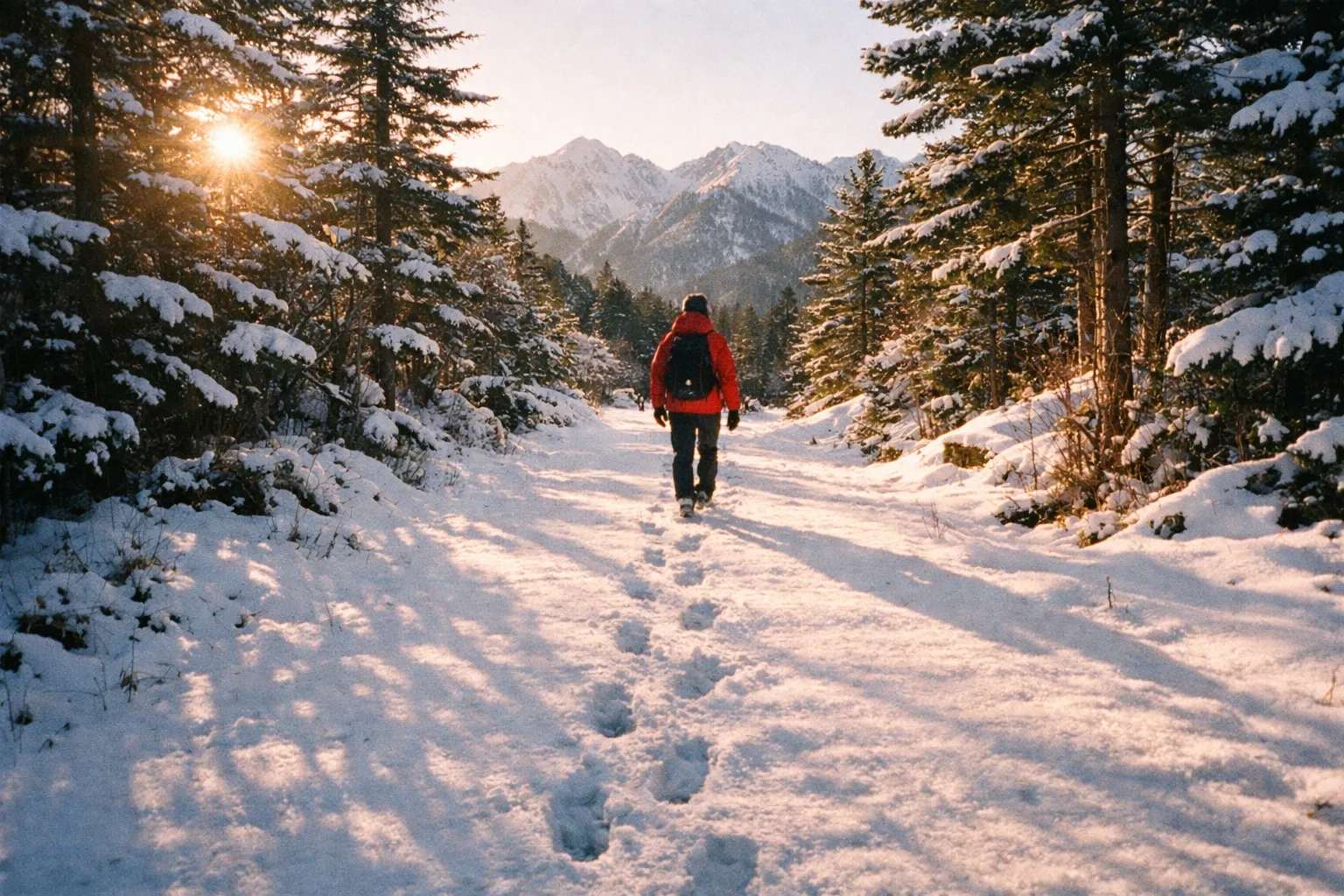
Clothing and footwear are where most people cut corners they shouldn’t. Waterproof insulated boots are non-negotiable. Layers work on a simple system: a base layer that moves sweat away from your skin, an insulating mid-layer, and a waterproof outer shell. Add thermal gloves, a warm hat, and UV-protective sunglasses - snow glare is genuinely punishing at altitude, and people consistently underestimate it.
Weather at high elevation shifts fast. A clear morning can become a whiteout by early afternoon, and the forecasts for specific peaks are more useful than regional ones. I check the Japan Meteorological Agency’s mountain forecasts the night before and again the morning of any winter outing. Have a turnaround plan before you start, and stick to it.
Avalanche risk is the part that demands the most respect. Before any winter trek in the Alps, I check the regional avalanche forecast and carry a beacon, probe, and shovel. These aren’t optional extras for cautious people - they’re standard kit for anyone venturing onto snow-covered slopes. If you don’t know how to use them, take a course or go with someone who does.
Wildlife encounters are less of a concern in winter - most of Japan’s larger animals are less active - but proper food storage still matters. Bears in Hokkaido and the northern Alps are not reliably hibernating through the entire season, and even in winter, a poorly stored pack is an invitation.
Spring hiking: mud, melt, and unpredictable weather
Spring is when Japan’s lower trails genuinely shine. I walked a section of the Nakasendo in late April a few years back, and the contrast with winter was striking - cherry blossoms still clinging on at elevation, the trail soft underfoot, the villages between post towns quiet and green. It’s a good time to be out. It also requires a different kind of attention than summer hiking.
Footwear matters more in spring than in any other season. Snowmelt turns trails muddy and slick, particularly on shaded north-facing slopes. Waterproof boots with a solid grip handle most of it; gaiters help if you’re going anywhere that’s still partially snow-covered.
Layering is still essential, but the layers shift. You’re not dealing with deep cold - you’re dealing with temperature swings of 15 degrees between morning and afternoon, plus the near-certainty of rain at some point. Lighter insulation, a packable rain jacket, and the willingness to shed and add layers throughout the day.
Weather forecasts in spring deserve more attention than in summer. Fronts move through quickly, and a trail that’s pleasant at 9am can be slippery and cold by noon. Plan your start time around the most stable part of the day, and always have rain gear accessible - not buried at the bottom of your pack.
One thing worth knowing: spring is when some animals emerge from winter ranges, particularly in Hokkaido. Bears become more active as snow retreats. It’s not a reason to avoid the trails, but it’s a reason to make noise and stay aware.
Wildlife awareness on the trail
Japan’s wildlife is genuinely interesting - Japanese macaques, tanuki (Japanese raccoon dogs), deer, and in the north, brown bears. On my first trip through Shiretoko National Park in Hokkaido, I saw a brown bear from the road. It was about 200 meters away and completely uninterested in me. That’s the ideal outcome, and it’s also the result of doing things right.
Bear bells are standard kit in Hokkaido and the northern Alps. The logic is simple: bears that hear you coming have time to move away. Surprise encounters are where things go wrong. I clip a bell to my pack strap on any trail where bears are possible, and I make extra noise on blind corners and in dense forest where visibility drops. For a deeper look at the full range of species you might encounter, Wildlife in Japan: Hokkaido Bears to Okinawa Sharks covers the regional breakdown in detail.
Carry bear spray if you’re in Hokkaido or the northern Alps. Know how to use it before you need to. Food storage matters too - hanging food or using bear-proof containers at camp, and never leaving anything scented near your sleeping area.
Leave-no-trace principles apply across all of Japan’s national parks, but in places like Daisetsuzan and Yakushima they’re enforced, not just suggested. Waste carry-out is a park regulation, and violations can result in fines and being turned away from huts (6)(2). Pack out everything you pack in. Stay on marked trails. These aren’t just ethical positions - they’re the rules.
Where to hike in Japan for beginners
If you’re new to multi-day hiking, the right move is not an alpine ridgeline. The best beginner hiking trails in Japan have clear signage, frequent lodging, and straightforward transport access.
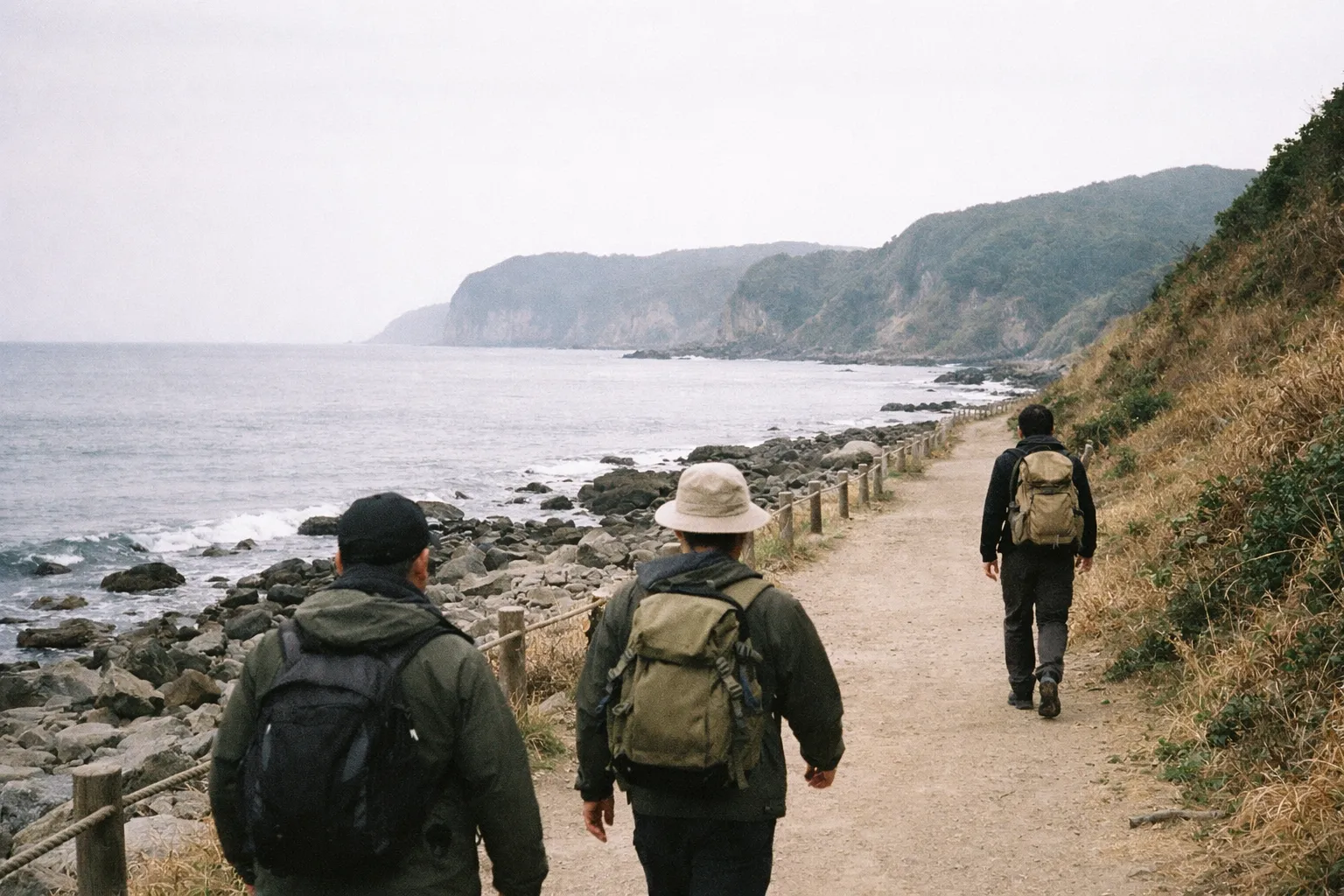
Best beginner overnight hikes:
- Kumano Kodo (Nakahechi route), Wakayama: The most beginner-friendly pilgrimage option. Well-signed and serviced, with minshuku (family-run guesthouses) clustered in villages like Takijiri and Chikatsuyu, and luggage transfer services that let you walk with a light daypack(3). Budget 6,000-12,000 yen (about USD 42-84) per night for lodging, as of July 2025 (3).
- Kamikochi, Japanese Alps: A flat valley floor with boardwalks, riverside trails, and a hut at the far end. You can do an easy out-and-back overnight without serious climbing - the Konashidaira campground and Myojin area are the standard first-night stops.
- Hakone and Nikko: Both are easy day-trips from Tokyo with straightforward overnight loops, onsen towns, and good public transport.
For day hikes, official guides point beginners toward short, well-marked trails near cities and low-elevation pilgrim sections (6). Mount Takao, a quick train ride from central Tokyo, is the classic starting point - paved, well-signed, and busy enough that you’re never far from other hikers.
Etiquette note: Many minshuku and mountain huts are shoes-off establishments. You’ll be given slippers at the entrance, with a separate pair for the toilet. Do not wear the toilet slippers back into the common room. It sounds minor. It’s the kind of mistake that gets noticed instantly and remembered.
How difficult is the Kumano Kodo?
The Kumano Kodo’s spiritual reputation leads a lot of people to assume it’s an easy stroll. It isn’t. The Tanabe City Kumano Tourism Bureau officially grades routes on elevation gain, trail conditions, and remoteness, and they advise a “good level of fitness” for many sections(3).
The Nakahechi route is the most accessible - well-signed, serviced, and the standard choice for first-timers. The Kohechi and Iseji routes are far more remote and strenuous, with bigger climbs and fewer facilities. For beginners, the practical approach is to use the official difficulty ratings to string together shorter, lower-difficulty Nakahechi stages into a comfortable 2-day or 3-day itinerary, rather than tackling the hardest sections without a baseline of fitness.
Most pilgrim lodgings provide futons, so you don’t need to carry a sleeping bag. With luggage transfer between guesthouses, you can walk carrying little more than water, snacks, and a rain layer. For a first multi-day hike, it’s about as manageable as it gets.
Mount Fuji and the Yoshida Trail
Mount Fuji is Japan’s most climbed mountain, and the Yoshida Trail is the route to take if it’s your first time. Japan’s official Fuji guide describes it as “relatively the easiest route,” with mountain huts roughly every 60 to 90 minutes of walking.
Yoshida Trail logistics:
- Season: July to early September only.
- Access: Bus from Tokyo to Kawaguchiko (about 2,000 yen / USD 14), then a local bus to the Subaru Line 5th Station (about 1,950-2,000 yen / USD 14).
- New access fee: From July 2025, the four busiest summit routes - including Yoshida - charge a 4,000 yen (about USD 28) conservation and safety fee per climb (8). Budget for it; checkpoints can refuse hikers who haven’t paid.
The smartest approach is a 2-day sunrise hike: walk to a hut around the 7th or 8th station, sleep a few hours, and summit before dawn. Splitting the climb reduces altitude sickness and fatigue, and the huts every 60-90 minutes make it manageable for fit beginners.
Don’t attempt a “bullet climb” - straight up and down without sleep - in one push. It’s the most common cause of altitude trouble on the mountain, and it’s not a badge of honor.
More 2-day hikes in Japan
Once you’re comfortable with an overnight, these 2-day routes open up the higher country.
- Kamikochi to a hut and back (Japanese Alps): From the Kamikochi valley floor, climb to a single hut - Yokoo or one of the Karasawa huts - spend the night, and return. It’s the standard gateway into the high Alps without committing to a full traverse.
- Daisetsuzan, Hokkaido: A day-plus route across volcanic plateaus with a hut or campsite overnight. This is hiking in Hokkaido Japan at its best - fumaroles, alpine flowers, and far fewer crowds than the Honshu Alps.
- Fuji Yoshida 2-day sunrise ascent: Covered above - a hut at the 7th or 8th station turns the climb into a paced overnight.
Getting from Tokyo to Kamikochi runs roughly 10,000-15,000 yen (USD 70-105) round-trip by train and bus, plus your hut nights (7)(2).
3-day hut-to-hut hikes in the Japanese Alps
This is the heart of serious hiking in Japan Alps territory. The classic is the Kamikochi-Yari-Hotaka circuit, connecting Mount Yarigatake (the “Japanese Matterhorn”) and Mount Okuhotakadake - two of the country’s most recognizable peaks.
It’s a hut-to-hut route with 2 hut nights, putting total accommodation at roughly 20,000-24,000 yen (USD 140-170) at July 2025 peak-season rates(2). Expect cumulative elevation gain in the thousands of metres, exposed ridgelines, and sections of chained scrambling. Bring a helmet. Have real alpine experience before you commit to this one.
For more advanced hikers, the Alps deliver longer punishment. Multi-day routes like a 5-day, 40-mile circuit rack up around 14,000 feet (4,300 m) of cumulative ascent (7). Misjudging the time and elevation is one of the most common and dangerous mistakes hikers make in Chūbu-Sangaku National Park (7). The terrain doesn’t forgive optimistic planning.
Booking warning: Japan Alps huts require advance reservations during July through September. Demand is high and last-minute walkers risk being turned away or pushed into limited tent sites (2)(10). Book months ahead, not weeks.
3-day hike on Yakushima Island
Yakushima, off the southern tip of Kyushu, is one of the best island treks in Japan. The terrain runs from ancient cedar forests and moss-draped valleys to high open ridgelines, and a 2-night / 3-day traverse crosses much of that range (5).
The big practical advantage is the shelter huts scattered along the route. These are basic and communal, and most don’t charge the fixed rates of the Alps huts - which keeps both your pack weight and your costs down (5). You’ll need to register or get a permit with local authorities, and space is first-come, so arrive early.
One thing nobody should underestimate: Yakushima is one of the wettest places in Japan. Heavy rain is the norm, not the exception, and local guides stress robust waterproof gear (5). I’ve heard from more than a few hikers who packed a “good enough” rain jacket and spent two days soaked through. Don’t be that person.
Other types of multi-day
Beyond the Alps, Fuji, and the islands, Japan has multi-day hiking that doesn’t fit the standard mold.
- Pilgrimage routes: The Kumano Kodo and sections of the Shikoku 88-temple circuit combine walking with centuries of religious history and reliable lodging (6).
- Historic footpaths: Old post roads like the Nakasendo - particularly the Magome-to-Tsumago and Tsumago-to-Nagiso sections - let you walk between preserved Edo-era post towns. Easy terrain, genuinely atmospheric.
- Volcanic and fumarole walks: Hokkaido’s national parks offer geothermal landscapes of hissing steam vents and barren volcanic ground, a genuinely strange contrast to the green of the south (6).
If you want otherworldly terrain, the volcanic areas of Hokkaido and the high ridges of the Japanese Alps deliver it - geothermal features combined with the kind of historic footpaths that national-park materials highlight (6). If you’re looking to balance these wilder days with something more restorative, a balanced 10-day itinerary is a useful resource for building a trip that does both.
Japan hiking itinerary: what to expect and what it costs
A multi-day hike in Japan usually means hut-based lodging, which shapes both your pack and your budget. Here’s the practical reality.
Mountain hut and campsite costs: Hut prices in the Japanese Alps have climbed sharply since COVID. The Karasawa Hütte now charges around 12,000 yen (USD 84) per night without meals in peak season (as of July 2025) - roughly 50% higher than pre-pandemic rates (2). Full-board hut stays at huts like Jonengoya commonly exceed 10,000 yen (USD 70) per person per night, with tent sites priced lower but still regulated (10)(2).
What that gets you: A futon in a shared room, often packed shoulder-to-shoulder in peak season, and access to hot meals you can buy on site. Hut dinners run about 1,500-2,500 yen (USD 11-18), which means you can carry far less food and fuel (2)(10).
Gear basics: For day hiking, you’ll want sturdy boots (around USD 100-200; Montbell is the leading local outfitter with shops in most cities), rain gear (USD 80-150), and a 20-30 L daypack (6). For beginner overnights, bump up to a 30-40 L pack with a change of clothes and light sleeping gear - though pilgrim lodgings and huts that provide bedding cut that load considerably(3). If you’d rather not ship gear or travel heavy, renting ski, snorkel, cycling, and hiking gear across Japan is a practical alternative worth knowing about before you pack.
Guided options: Small-group guided hikes run roughly USD 100-200 per day in popular regions. For first-timers, they’re worth considering - not just for safety, but to learn Japanese trail etiquette and hut manners (correct waste disposal, futon arrangement, quiet hours) that aren’t always obvious from a guidebook (6)(3).
Globally, hiking tourism was valued at USD 47.8 billion in 2025 and is projected to nearly double by 2034 (9). In practice for Japan, that means busier trails, more infrastructure, and - as Fuji’s new fee shows - more managed access. Book early.
Frequently Asked Questions
- What should I pack specifically for winter hiking in Japan?
- Bring waterproof insulated boots, layered clothing including a moisture-wicking base layer, insulating mid-layer, waterproof shell, thermal gloves, warm hat, and UV-protective sunglasses. Also carry avalanche safety gear if venturing into snow-covered slopes.
- Are there any regulations about waste disposal on Japan's hiking trails?
- Yes, in national parks like Daisetsuzan and Yakushima, waste carry-out is strictly enforced. Violations can lead to fines and being denied entry to huts. Always pack out what you bring in.
- How can I reduce the risk of bear encounters while hiking?
- Use bear bells to make noise, especially in dense forest or blind corners, carry bear spray if in Hokkaido or northern Alps, and store food properly using bear-proof containers or hanging methods.
- Is it possible to hike the Japanese Alps without alpine experience?
- Some routes like Kamikochi offer easier day hikes and overnight stays suitable for beginners, but serious alpine traverses with exposed ridges and scrambling require real alpine experience and proper gear.
- How early should I book mountain huts during peak season?
- Book several months in advance for July through September, as huts fill quickly and last-minute hikers risk being turned away or limited to tent sites.
- What is the etiquette regarding shoes in mountain huts and minshuku?
- Most huts and minshuku require you to remove shoes at the entrance and provide slippers. Use the slippers only in common areas, and never wear toilet slippers back into the main rooms.
- Are guided hikes recommended for first-timers?
- Yes, guided hikes can be valuable for safety and to learn Japanese trail etiquette and hut manners that are not always obvious from guidebooks.